Correction
What Is Paint Correction? A Plain-English Guide for Car Owners
By Rocco van Wyk · Updated 28 September 2026 · 4 min read
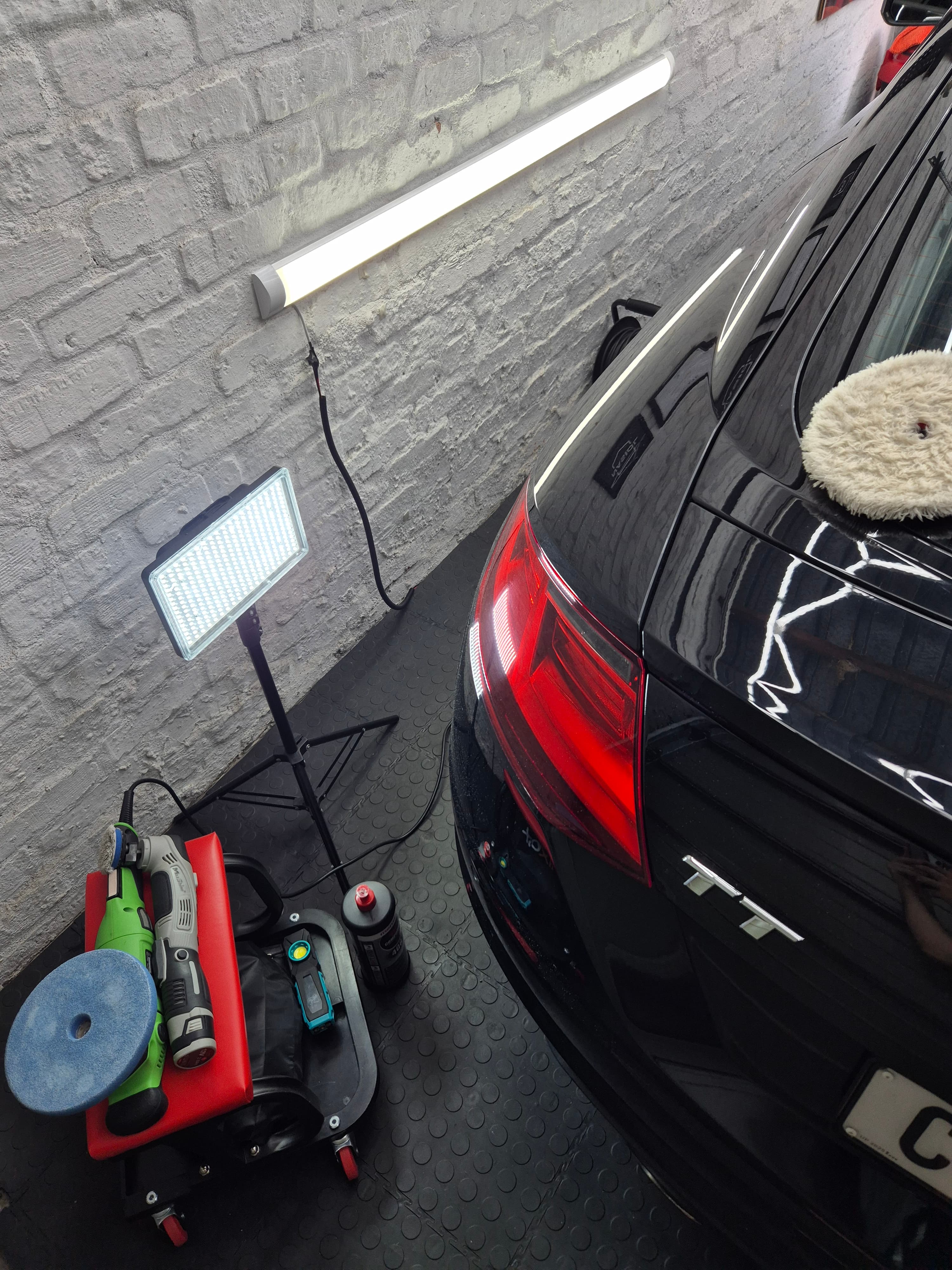
Paint correction is a machine polishing process that permanently removes defects from a car's clear coat by levelling a microscopically thin layer of it. It eliminates swirl marks, light scratches, oxidation and water spot etching. Unlike a polish or glaze, which temporarily fills defects, correction removes them, so the result does not wash away.
The word "correction" is accurate in a way that "polish" is not. Polishing can mean anything from a bottle of filler-heavy product wiped on by hand to a multi-hour machine process. Correction refers specifically to removing defects rather than hiding them, and the difference shows up the first time it rains.
What is actually happening to the paint?
Modern car paint is layered: primer, then base coat which carries the colour, then clear coat on top. The clear coat is what you see, what shines and what gets damaged. It is typically somewhere in the region of 40 to 60 microns thick — roughly half the thickness of a sheet of paper.
Almost every defect you notice sits in that clear coat, not in the colour. Swirl marks are thousands of shallow scratches. Oxidation is degraded clear coat surface. Water spot etching is a mineral burn into the clear coat. Correction works by using an abrasive compound and a machine polisher to remove a few microns of clear coat evenly across the panel, taking the defect with it and leaving a flat, uniform surface that reflects light cleanly.
Because correction consumes clear coat, it is not something a car can have done endlessly. A well-looked-after car might be corrected three or four times in its life. One that is aggressively compounded every year will eventually have clear coat failure. This is the reason a good detailer measures paint depth before starting and uses the least aggressive process that achieves the result.
What does paint correction fix?
| Defect | Correctable? | Notes |
|---|---|---|
| Swirl marks and wash marring | Yes | The most common reason people book correction |
| Light scratches | Yes | If your fingernail does not catch in it, it usually comes out |
| Oxidation and dull, chalky paint | Yes | Very dramatic improvement on older single-stage paint |
| Water spot etching | Usually | Depends how long it sat and how deep it burned |
| Bird dropping etching | Usually | Same caveat — deep etching may need wet sanding |
| Holograms and buffer trails | Yes | Damage from a previous bad polish job |
| Deep scratches through the clear coat | No | If your fingernail catches, correction can soften it, not remove it |
| Stone chips | No | Needs touch-up or respray |
| Clear coat peeling or failure | No | Needs a respray of the affected panel |
| Dents and creases | No | Paintless dent removal is a different trade |
How many stages does my car need?
A single-stage correction uses one compound-and-polish step and removes roughly 60–80% of visible defects. A two-stage correction adds a cutting step first and removes 85–95%. A full multi-stage correction, sometimes including wet sanding, targets close to complete defect removal and is reserved for show cars and severely damaged paint.
Which one a car needs is decided by inspecting the paint under strong directional light, not by a price list. A two-year-old car that has only been hand washed might need a single stage. A five-year-old black car that has been through automatic brush washes weekly will need two, and honestly might not reach perfection even then.
Be sceptical of anyone quoting a correction stage over the phone without seeing the car. The inspection is the diagnosis.
What does the process look like?
- Wash and decontaminate. Snow foam pre-wash, two-stage safe wash, then chemical decontamination and iron fallout removal to dissolve embedded metal particles.
- Clay bar. Physically lifts bonded contamination the chemicals did not release. The paint should feel like glass afterwards.
- Inspect and measure. Paint depth readings and strong light to establish how much clear coat there is to work with and how deep the defects run.
- Test panel. A small area is corrected first to confirm the combination of pad, compound and machine speed. This step is what separates a professional from an enthusiast with a polisher.
- Correction passes. Panel by panel, cutting then refining, checking under light after every panel.
- Prep wipe-down. A solvent wipe strips polishing oils so the true result is visible — and so nothing is hidden by residue.
- Protect. Freshly corrected paint is bare and vulnerable. It needs a sealant or ceramic coating immediately, which is why the two services are almost always booked together.
What does paint correction cost in Cape Town?
A multi-stage correction at Foambox is R3 500, which includes the wash, clay bar and iron fallout removal package, full swirl and defect correction with wet sanding where required, and finishing to a mirror gloss. Across the Cape Town market, expect roughly R2 000–R3 000 for single-stage work and R3 000–R6 000 for genuine multi-stage correction, scaling with vehicle size and paint condition.
The cost is almost entirely labour. A proper two-stage correction on a mid-size car is a full day of skilled work, sometimes two. See the paint correction package for exactly what is included.
Frequently asked questions
Is paint correction permanent?
The defects removed are gone permanently — that clear coat has been levelled. New defects can appear if the car is washed badly, which is why correction is usually paired with a coating and a proper wash routine.
Will paint correction remove a deep scratch?
Run a fingernail lightly across it. If it catches, the scratch has gone through the clear coat and correction will reduce its visibility but not remove it. If it does not catch, there is a good chance it comes out completely.
Is paint correction safe for my car's paint?
In trained hands, yes. It removes a controlled few microns of a layer that is designed to be serviceable. It becomes unsafe when it is done aggressively, repeatedly, or without measuring paint depth first — particularly on resprayed panels, where the clear coat is often thinner than factory.
How long does paint correction take?
Single stage on a small car, most of a day. Two-stage on a larger vehicle, one to two days. Add curing time if a ceramic coating follows. Anyone promising a correction in three hours is describing a polish, not a correction.
Do I need correction before ceramic coating?
Only if the paint has defects — but on any car older than about two years, it usually does. Coating over swirl marks seals them in for the life of the coating.